THE STORY OF THE GAME
I invented FRONTIERS back in 2002, when my father retired from his work as a physicist at Rafael.
My father, Dr. Moshe Gvishi, was an amateur chess player. As a teenager, he won several chess tournaments and was considered to have a very promising future in the game had he chosen to pursue it professionally. Instead, he focused on mathematics and physics, eventually becoming one of Israel’s leading physicists and even leading significant research for NASA.
So when my father was 67 and I was 34, we started playing chess together again, just as we had when I was a child.
There was only one problem.
It did not take long for both of us to return roughly to the level we had reached at fourteen. My fourteen-year-old level was somewhat above average. His fourteen-year-old level was that of a gifted chess player who could remember complete games by heart and who had even defeated Cherniak, an Israeli champion and at one point one of the world’s leading players, in a simultaneous exhibition.
I had no chance.
But I could not accept the idea that my father was simply more talented at chess than I was, because that might suggest he was simply smarter than me. That may still be true, but that is beside the point. 🤣
My conclusion was much more convenient: my father was beating me because almost every position we reached was a position he had effectively encountered before, while I had not.
So I had two choices.
I could close the gap: read grandmaster books, join chess sites and play thousands of games.
Or I could change the rules of the game in my favor.
I chose option two.
I tell this story in some detail because the reason I invented FRONTIERS is still relevant to millions of people today. Many people do not play chess because they have little experience with it, or perhaps do not even know all the rules. Chess knowledge is often passed down inside families, from father or grandfather to child. And people generally do not enjoy sitting across from someone who has years of experience and immediately feeling stupid or less intelligent.
Years later, after watching many serious chess players play FRONTIERS and love it, I reached another conclusion: the fact that everything is new is itself an enormous advantage.
You do not need years in a chess academy before you can enjoy FRONTIERS. You can enjoy it from your very first game.
So, back to the invention.
I had decided to change chess. But how could I change it without going so far that my father would simply look at me and say, That isn’t chess anymore?
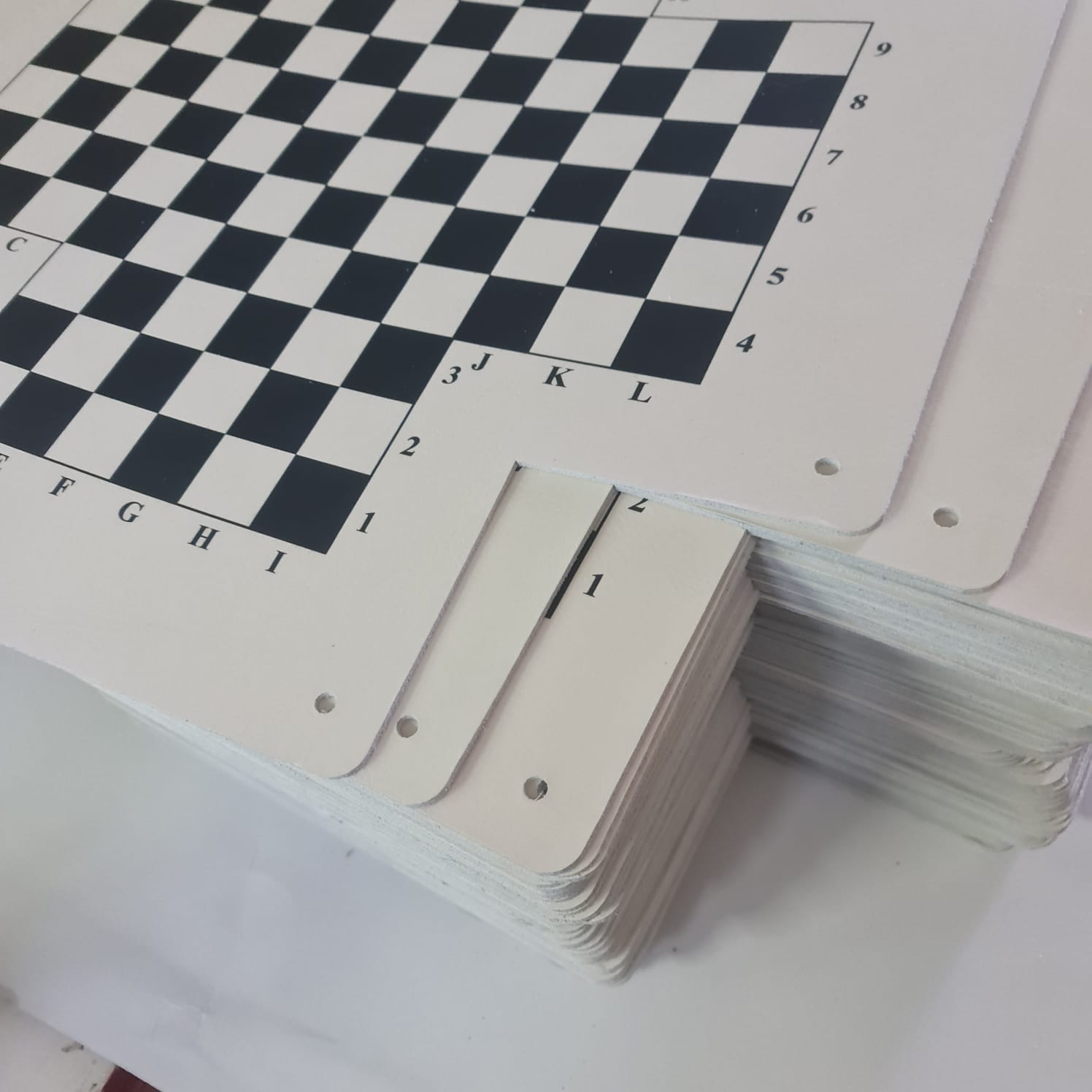
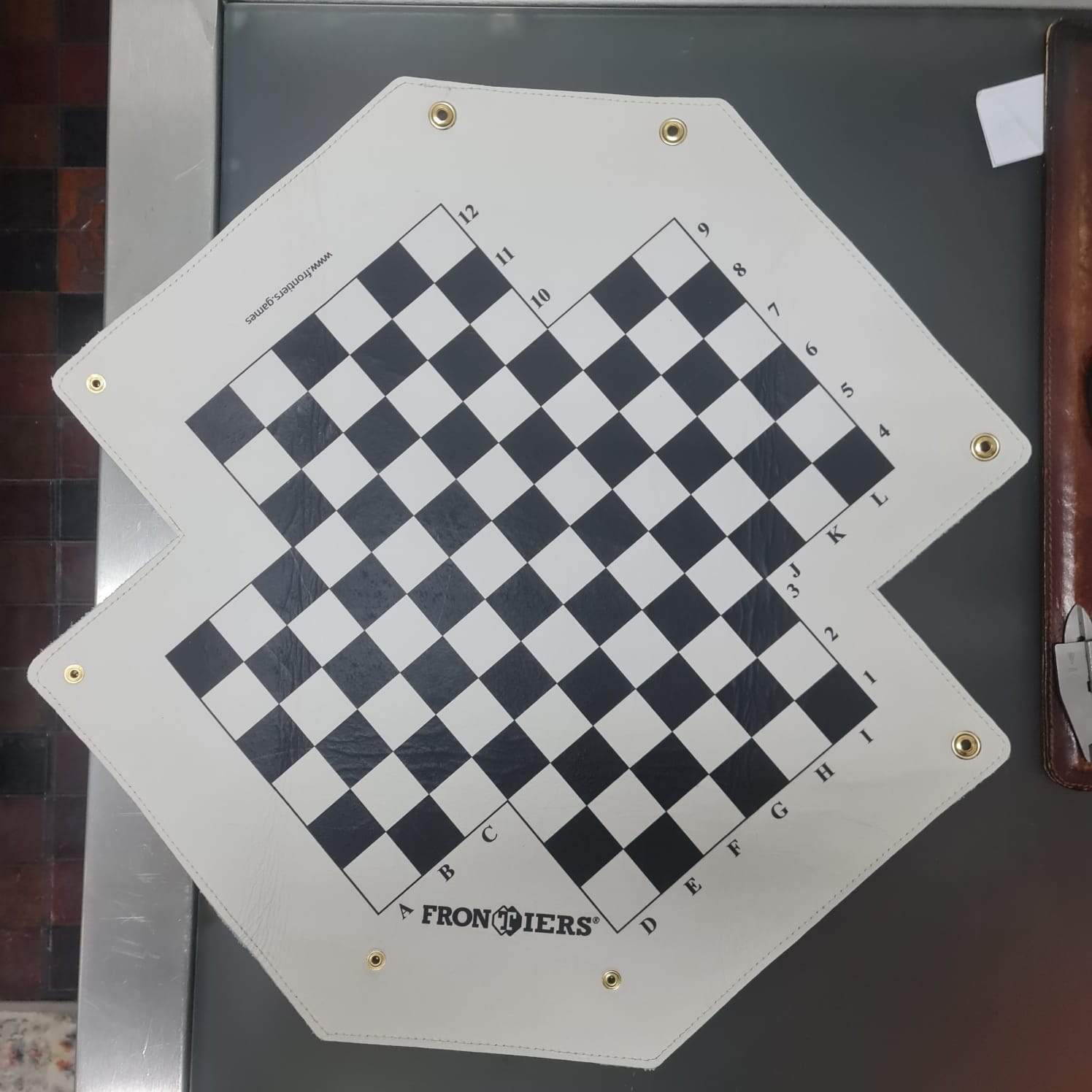
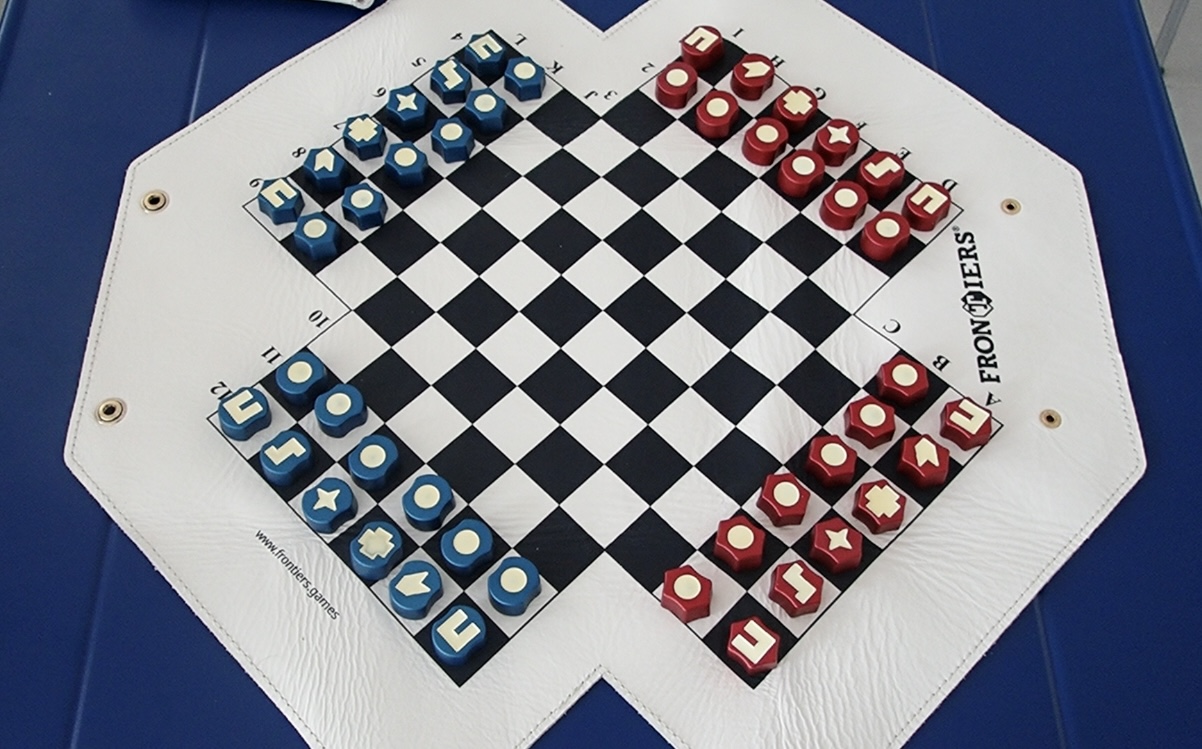
My first move was to change the shape of the board from a square to a cross, with each player controlling two armies, or fronts.
But I did not want the commander to control too many pieces, and I also wanted to avoid having two bishops operating on the same color. So I reduced each front to one bishop, one knight and six pawns. That created a front of twelve pieces instead of the sixteen pieces in traditional chess.
But because each player commands two fronts, each player actually controls an army of twenty-four pieces.
Then came the second idea, which was at least as radical and ultimately created much of the magic of FRONTIERS:
The commander gets two moves per turn, one on each front.
Think of beach volleyball: one player sets, the other spikes.
The two fronts have to cooperate. One creates the opportunity; the other exploits it. In that sense, FRONTIERS begins to resemble modern warfare, where success depends on coordination between separate forces.
By April 2002, I had built the first physical prototype and brought it to our family Passover gathering. The reaction was immediate.
My father, who had always respected my ability as an inventor, looked at it and said:
You’ve got something here.
Through the chess community, he helped me make my first connections. One of those connections eventually led me to Grandmaster Alon Greenfeld, former captain and coach of the Israeli national chess team and, around that period, a leading coach on Garry Kasparov’s chess platform.
Greenfeld was also closely involved with Junior, the world-champion chess program developed by Amir Ban and Shay Bushinsky.
Through Greenfeld I reached many of the leading figures in Israeli chess. The response to the invention was extremely enthusiastic.
But enthusiasm was not a business.
I realized that if FRONTIERS was going to become a real product, it needed a digital version.
I recruited a childhood friend who was himself a chess fanatic, loved chess variants and also happened to write code. Together we created the first playable digital version using the Zillions of Games platform.
Again, the response was excellent. People played. We received a great deal of feedback.
But time passed, and I still could not see a business emerging from a successful game that people were playing online for free.
Then, during 2005, I began seeing publicity for the Israeli version of the television program The Sharks.
I applied and made it onto the show.
FRONTIERS was a hit there too. The Sharks competed over who would get to invest in me and the venture. The winner was Zeev Holtzman, then CEO and Chairman of Giza Venture Capital.
And just like that, FRONTIERS entered Giza’s portfolio, with the ambition of becoming its path into the emerging virtual world.
After an investment of $225,000, however, we still did not have a stable product. The website kept crashing, and at the time it was far from obvious to the fund how an online game could actually make money.
My own insistence that the game should run on a server and be playable from different devices was also rather ahead of its time. It certainly did not help the stability of a system that effectively needed a server farm just to stay alive.
After two years of development, by the end of 2007 the fund had had enough, and we separated on good terms.
There is a formal separation agreement, and everything stated here about that period is my responsibility alone and does not represent any future partner.
Then came the 2008 financial crisis.
That combination was disastrous for the venture. Private investors were hardly eager to enter a project that a half-billion-dollar venture capital fund had just exited.
And so FRONTIERS went into hibernation.
An extraordinary product that had still never truly reached the world.
Now, twenty years later, I am back.
This time I returned essentially on my own, with AI coding agents and some help from friends, to finally realize the potential of FRONTIERS.
And today the website is live.
The next stages are multiplayer at scale, an AI engine capable of reaching superhuman strength, and competitive play for money.
Which brings us to why you are reading this.
If you want to become part of the history of how FRONTIERS became THE CLASSIC GAME OF FUTURE GENERATIONS, talk to me.
And transfer the appropriate amount of money into my bank account. 😜
But seriously, there is something I would value from the right partner even more than money.
Experience.
Experience building and scaling a business in the games industry, and the ambition to turn an already proven game concept into a business worth hundreds of millions of dollars.
Because the largest expense twenty years ago was development.
Today, development costs me a fraction of what they once did.
And there is one final irony.
Twenty years ago, the Chairman of Giza told me that FRONTIERS could conquer the world like Sudoku. He estimated that even in a minimum-success scenario it could be worth $50 million.
So why did he eventually leave the project?
At the time, he simply could not see how you make money from a game on the internet.
Twenty years later, that might be the funniest part of the whole story. 🤣